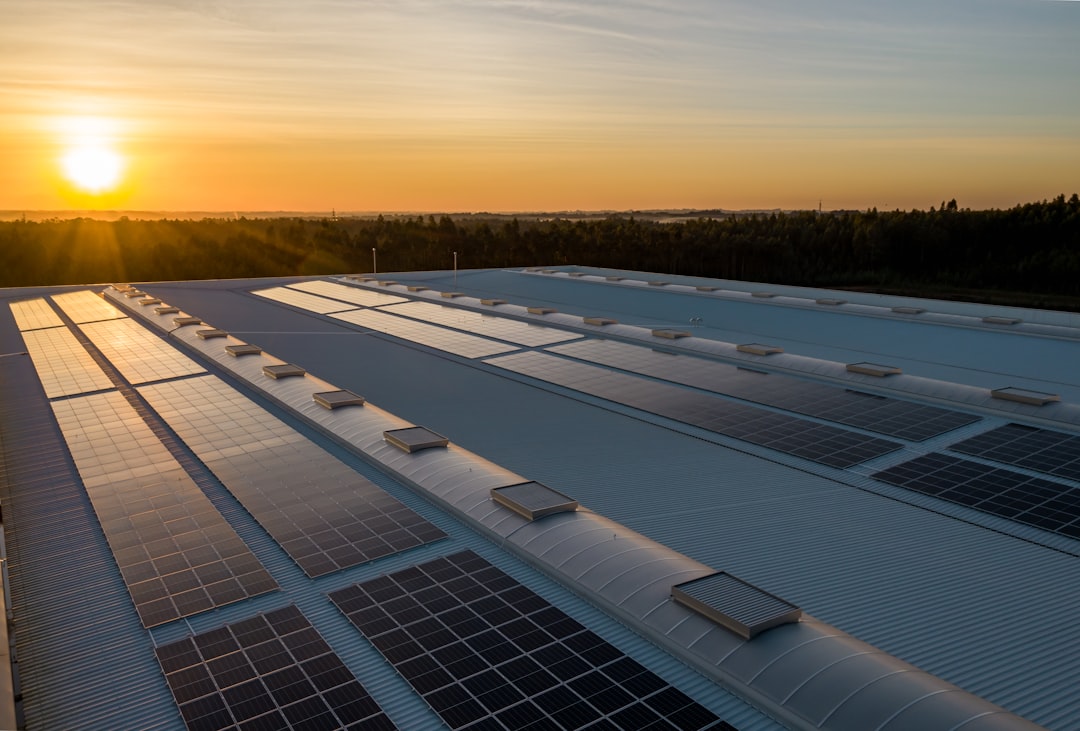
Flat roofs present both opportunities and challenges for solar panel installation. While they lack the natural tilt of a pitched roof, flat roof systems can be optimised by choosing the right mounting angle — and their accessibility often makes installation and maintenance easier. Here’s everything you need to know about flat roof solar in the UK.
How Flat Roof Solar Works
Solar panels need to be tilted toward the sun to maximise output. On a flat roof, this is achieved using mounting frames that hold panels at 10–20° — close to the optimal 30–35° but limited by the need to avoid frames casting shadows on the next row of panels.
Flat roofs are typically covered with EPDM rubber, built-up felt, bitumen, or GRP fibreglass. Any penetration of this waterproof membrane creates a potential leak point, which is why ballast mounting systems — which use concrete blocks or paving slabs to weigh down frames rather than drilling through the membrane — are the preferred option for most UK flat roofs.
Ballast vs Penetrating Mount Systems
| System | Method | Pros | Cons | Added Cost |
|---|---|---|---|---|
| Ballast mount | Weighted frames on membrane surface | No roof penetrations, reversible | Adds weight (30–50kg/m²), limit on panel density | £0–£200 extra |
| Penetrating mount | Bolts through membrane with sealed boots | More secure in high winds, allows tighter spacing | Penetrations must be waterproofed, affects roof warranty | £100–£300 extra |
| Hybrid systems | Combination of both | Balance of security and waterproofing | Complexity | £200–£400 extra |
Before installing a ballast system, a structural engineer should confirm your flat roof can handle the additional weight. Most modern flat-roofed extensions and commercial buildings can accommodate 20–30kg/m² comfortably, but older structures may need assessment.
Flat Roof Solar Costs 2026
Flat roof installations typically cost £500–£1,500 more than equivalent pitched roof systems due to the mounting frames and (for larger systems) structural assessment costs.
| System Size | Pitched Roof Cost | Flat Roof Premium | Flat Roof Total |
|---|---|---|---|
| 3kW | £4,000–£5,500 | +£500–£800 | £4,500–£6,300 |
| 4kW | £5,000–£7,000 | +£600–£1,000 | £5,600–£8,000 |
| 6kW | £7,500–£10,000 | +£800–£1,500 | £8,300–£11,500 |
Output vs Pitched Roofs
A flat roof system at 15° tilt will generate approximately 5–10% less than the same system on a 35° south-facing pitched roof. However, the flat roof’s flexibility in panel orientation (you can always face panels exactly south regardless of how the building faces) can partially offset this. On a pitched roof facing south-east or south-west, a flat roof system facing directly south may actually outperform it.
East-west split arrays — splitting panels across two sets of east and west-facing frames on the same flat roof — sacrifice peak noon output but provide more consistent generation across the day and require less row spacing. These are common on commercial flat roofs.
Planning Permission for Flat Roof Solar
Residential flat roof solar is permitted development in England if: panels project no more than 200mm above the plane of the roof; the panels are not on a wall fronting a highway; and the property is not listed or in certain conservation areas. Check with your local planning authority if in doubt.
Commercial flat roof solar usually requires planning permission — the threshold is 1MW in most cases, but local policies vary.
Maintenance Advantages
Flat roofs are more accessible than pitched roofs, making panel cleaning and system inspections significantly easier and cheaper. No scaffolding is typically needed for a single-storey flat roof — engineers can walk the surface safely. Annual cleaning costs are often lower.
Frequently Asked Questions
Q: Will ballast-mounted solar void my flat roof warranty?
A: Most flat roof system warranties (EPDM, GRP, Sarnafil) are not voided by ballast systems as long as the membrane is not pierced. However, some warranties specify that only approved contractors can work on the roof — check with your roofing manufacturer before proceeding.
Q: How far apart do rows of panels need to be on a flat roof?
A: Row spacing depends on panel tilt angle and latitude. At 15° tilt in the UK midlands, rows need approximately 1.5m between front edges to avoid winter shading. Your installer will calculate this using shadow analysis software.
Q: Is east-west orientation suitable for homes as well as commercial?
A: Yes — if your flat roof is large enough for two rows facing opposite directions, an east-west array can generate more total energy per day than a pure south-facing array, especially if you have battery storage to capture morning generation.
Q: Do flat roof systems need more maintenance than pitched roof systems?
A: Generally less, because access is easier. Annual cleaning and inspection can often be done safely from the roof surface without specialised access equipment.
Q: Can I install solar on a flat roof myself?
A: Not recommended. Working at height is regulated under the Work at Height Regulations 2005, and grid-connected solar must be installed by an MCS-accredited electrician. DIY installation voids the MCS certificate and SEG eligibility.