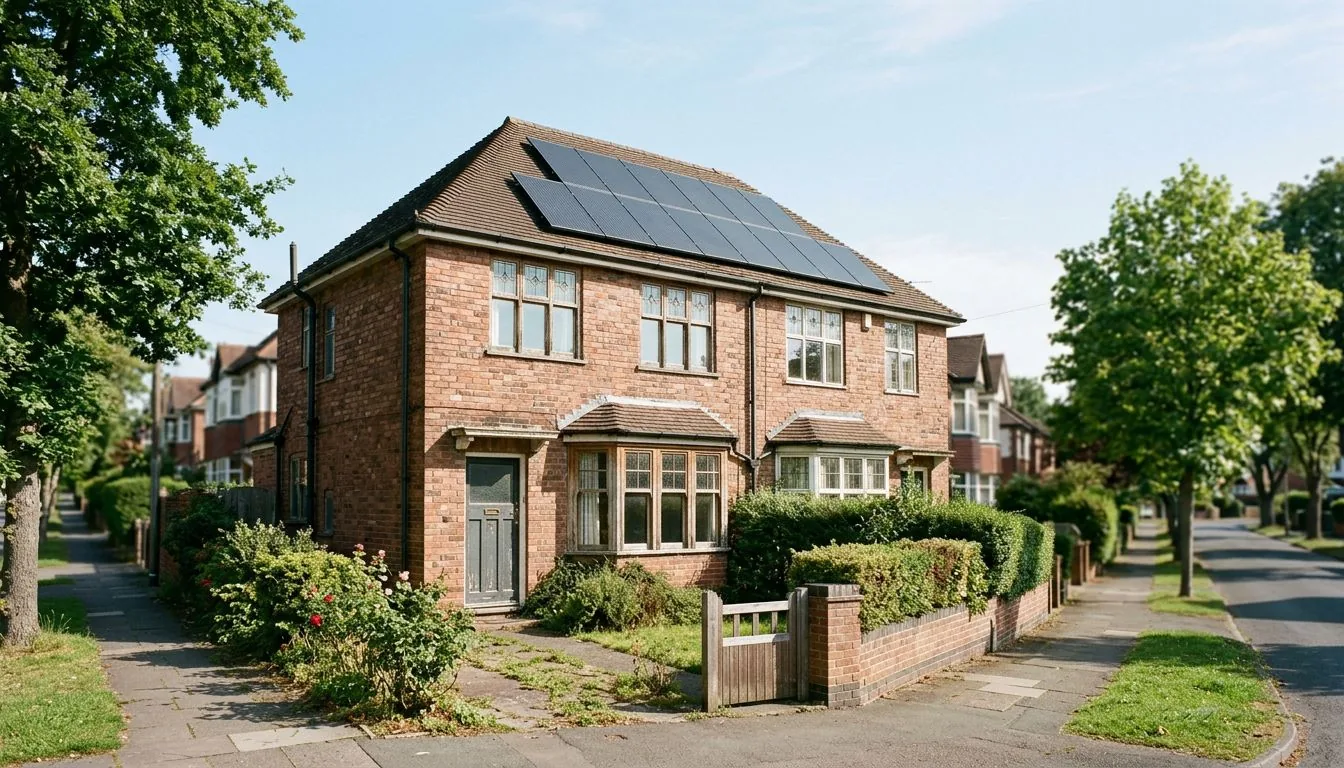
Quick answer: In Birmingham, 1 kWp of south-facing panels makes about 970 kWh a year, so a 4 kWp system makes about 3,870 kWh. That is almost exactly the UK reference figure, which makes Birmingham a fair test case for the national sums.
How much do solar panels make in Birmingham?
Solar panels Birmingham homeowners fit will produce close to what the national figures promise, because the city sits near the middle of the range. The EU’s PVGIS model gives about 970 kWh per kWp a year for south-facing panels at a 35-degree tilt. A 4 kWp system makes about 3,870 kWh. For the basics of a home system, see solar panel systems for homes.
Our UK reference point is Meriden, in the same county, at about 990 kWh per kWp. Birmingham is therefore only about 2% below it. Put another way, the city sits in the middle of the national range.
| Place | kWh per kWp a year | 4 kWp system a year |
|---|---|---|
| Manchester | 885 | about 3,540 kWh |
| Birmingham | 970 | about 3,870 kWh |
| Meriden (UK reference) | 990 | about 3,950 kWh |
| London | 1,025 | about 4,100 kWh |
All figures assume south-facing panels at 35 degrees. However, real roofs vary, so treat the table as a ceiling, not a promise.
Why Birmingham fits the national model
Our standard payback model assumes 900 kWh per kWp for a typical UK roof. It was built to reflect real roofs, with their mixed directions and some shade. Birmingham’s PVGIS figure is only about 2% below the national reference. A typical Birmingham roof should therefore land very close to the model.
On that model, a 4 kWp system costing about £7,500 saves and earns roughly £590 a year at October 2026 prices. Payback comes out at about 13 years. The wider range is 11-15 years, depending on price, roof and export tariff.
Prices include 0% VAT, which ends on 31 March 2027, when 5% returns. For the full breakdown, read what solar panels cost and save and try our solar panel calculator.
Sources: PVGIS, DESNZ solar PV cost data, HMRC VAT manual.
From back-to-backs to garden villages
Birmingham’s housing tells the story of its growth. The city’s last surviving court of back-to-back houses, at Hurst Street and Inge Street, is now a National Trust museum. Those homes were occupied from 1840 until 1977. They are a reminder that the city grew around small, cramped courts, long before anyone thought about roof space for panels.
Today, however, it is the Victorian and later housing that matters for solar, and it is far more varied.
Birmingham also has garden-village estates. Bournville Village and Bournville Tenants are both designated conservation areas. So are Moor Pool in Harborne, Austin Village and Selly Park.
Each estate has its own roofline and its own planning sensitivities. An array that is easy to fit on an ordinary suburban roof may need careful siting in a designed village.
Birmingham’s 29 conservation areas
Birmingham City Council recognises 29 conservation areas. They include the Jewellery Quarter, Moseley, Edgbaston, Harborne Old Village, Kings Norton and Sutton Coldfield’s High Street.
Most homes in these areas can still have solar. In England, since 27 August 2026, rooftop panels on a house are usually permitted development. A pitched roof array may stick out no more than 200 mm and must sit no higher than the ridge.
However, the limits tighten at walls and balconies. In a conservation area, panels on a wall, balcony or roof enclosure that fronts a highway are not permitted development. Listed buildings always need consent.
Check with the council if your home is listed, in a conservation area, or covered by an Article 4 direction.
Sources: Birmingham City Council conservation areas, National Trust history of the Back to Backs, SI 2026/896 on legislation.gov.uk.
Extensions, flat roofs and pigeons
Many Birmingham homes have a rear or side extension with a flat roof. That can be an easy place for panels, because the roof is often hidden from the street.
Under the English rules in force since 27 August 2026, flat-roof panels may stand up to 600 mm above the roof. Installers normally use tilted frames to lift output. Read about flat roof mounting options before you pick a design.
Pigeons are a common urban problem because they nest under panels if you leave a gap. Mesh and clips solve it, and the cost is worth including in your quote. See pigeon-proofing options.
Flats, renters and plug-in kits
If you live in a flat, rooftop panels are not usually your decision, because blocks of flats have separate planning rules. Plug-in solar is also excluded on timber.
A plug-in kit may suit. Since 27 August 2026, kits up to 800 W that meet the government’s product specification can be plugged into a normal socket in Great Britain. You must tell your network operator, use only one kit per home, and never use an extension lead. Renters and leaseholders should get landlord or freeholder consent first.
Read more about plug-in balcony solar kits and small plug-and-play systems.
Buying a Birmingham home that already has panels
Some Birmingham homes now come with panels. If you are buying one, check who owns the system and whether it has an MCS certificate. You need that certificate to be paid under the Smart Export Guarantee.
Our guide to buying a house with solar panels lists what to ask the seller.
Grid connection and export in the West Midlands
Birmingham’s network operator is National Grid Electricity Distribution (West Midlands). Your installer should handle the application, so ask for it in writing.
There is no fixed Smart Export Guarantee rate. Each supplier sets its own, so it pays to compare. As at October 2026, OVO’s open SEG tariff pays 4p per kWh to customers of any supplier, while its SEG Beyond Exclusive tariff pays 12p, but only to OVO electricity customers on systems under 30 kW.
Our model assumes 12p, a rate you can get by importing from the same supplier. Open-market rates run at about 3-6p.
Sources: OVO Smart Export Guarantee, gov.uk on the Smart Export Guarantee.
EVs and batteries
If you charge an EV at home, daytime solar can cover part of it. See charging an EV from solar for what to size.
Get Birmingham quotes
Ask each installer to model your own roof, not a city average. Get quotes from local installers through this site, then compare at least two.