Quick answer: In Bristol, 1 kWp of south-facing panels makes about 1,020 kWh a year, so a 4 kWp system makes about 4,090 kWh. That is about 3% above central England. A good Bristol roof therefore earns more per panel than in most cities in our table.
How much do solar panels make in Bristol?
Solar panels Bristol homeowners fit are among the better performers in England. Using the EU’s PVGIS model, 1 kWp of south-facing panels at a 35-degree tilt makes about 1,020 kWh a year. A 4 kWp system makes about 4,090 kWh. For the basics of a home system, see our residential solar panels overview.
The central-England reference is 990 kWh per kWp. Bristol is about 30 kWh per kWp above it.
However, the gap with the north is larger. A 4 kWp system makes about 550 kWh more in Bristol than in Manchester. At our model’s blended value of about 16p per kWh, that is roughly £90 a year. The blend assumes 30% of output is used at home at 26.32p and 70% is exported at 12p.
The south-west gets stronger as you go west. Cardiff is 1,030, across the Severn. Swansea is 1,040. Plymouth, at 1,100, is the highest figure in our table. See what solar generates in Wales for the Welsh picture.
What a higher yield is worth
Our standard model assumes 900 kWh per kWp on a typical UK roof. For a 4 kWp system costing about £7,500, that earns and saves about £590 a year and pays back in about 13 years.
A south-facing roof in southern England can manage 1,000 kWh per kWp or more. At 1,000, the model gives about £650 a year and a payback of about 11.5 years. A typical Bristol roof should therefore land between those two cases, at roughly 12 years. That is an estimate from the model, not a quote.
Prices include 0% VAT, which ends on 31 March 2027. After that, 5% returns. For the full sums, read solar panel costs and savings in the UK. For a sober view, see an honest look at whether solar pays off.
Use our solar panel calculator to estimate system size before you ask for quotes.
Sources: PVGIS, DESNZ solar PV cost data, HMRC VAT manual.
Georgian terraces, Victorian streets and hills
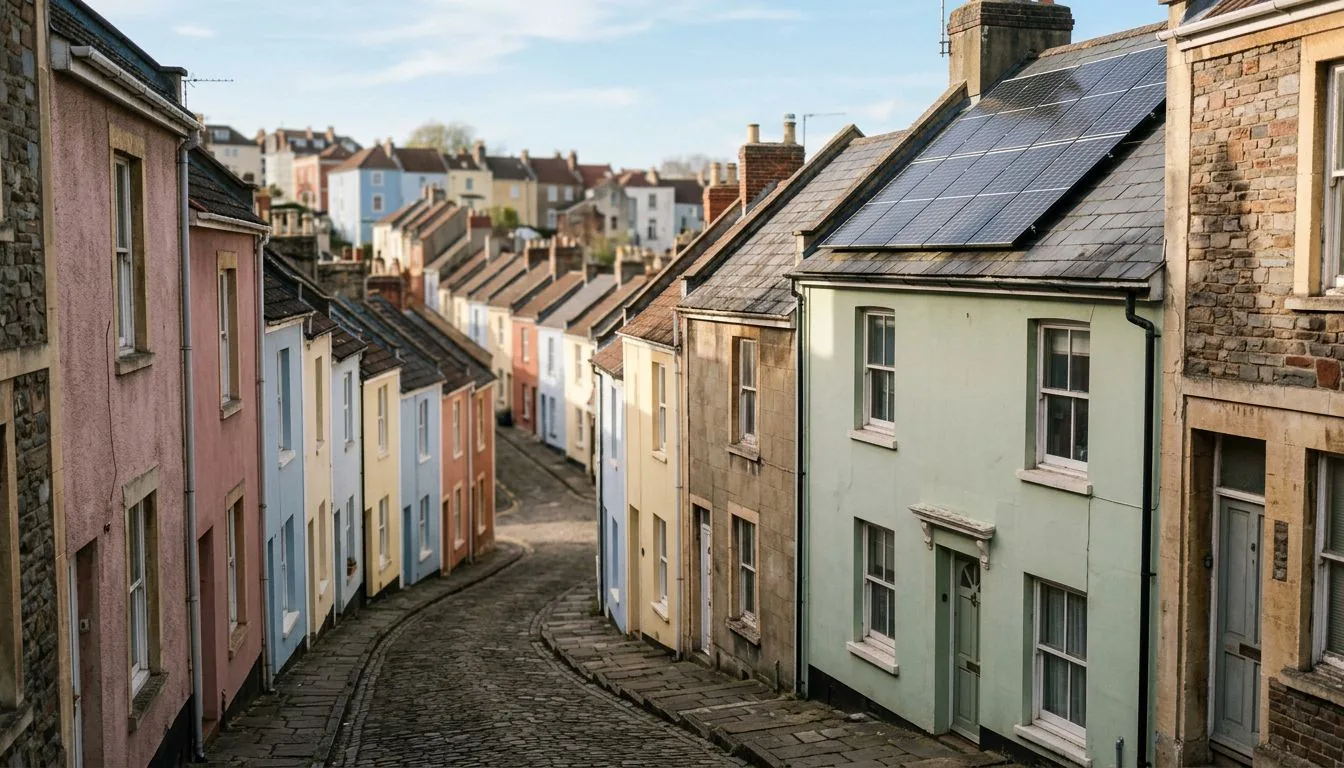
Bristol’s housing is as varied as its landscape. Clifton has Georgian terraces, including pastel rows that overlook the suspension bridge. South of the river, Southville and Totterdown are known for Victorian and Edwardian terraced houses, many of them painted in bright colours.
Totterdown rises steeply from the river. On a hillside like that, rows of houses sit on different levels and face different ways, so some roofs get full sun while others are shaded by the houses above or across the valley.
Therefore, the first question for a Bristol roof is not “how big”, but “how much direction and shade”. PVGIS runs for London show the cost of direction. South-east and south-west roofs give about 93-95% of a south-facing roof. East or west roofs give about 80%. North-facing roofs give only about half.
A good Bristol installer will survey your slope and shade before they quote.
Bristol’s 34 conservation areas
Bristol City Council’s planning data lists 34 conservation areas. They include Cotham and Redland, College Green, Redcliffe, St James and Portland and Brunswick Square.
In England, since 27 August 2026, rooftop solar on a house is usually permitted development. A pitched roof array may stand no more than 200 mm proud of the roof and no higher than the ridge. On a flat roof, the limit is 600 mm.
In a conservation area, roof panels are no longer barred just because they face a road. Panels on a wall, balcony or roof enclosure fronting a highway still need consent. Listed buildings need consent too.
Bristol also publishes Article 4 directions. The Cotham and Redland one, in force since 4 November 2012, covers demolishing front garden walls, fences and gates, and forming hard standings. It does not mention solar panels. Always check with the council.
Where appearance is the sticking point, compare solar tiles versus panels. Tiles look different, although they are not right for every roof.
Sources: Bristol City Council Article 4 directions, planning.data.gov.uk for Bristol, SI 2026/896 on legislation.gov.uk.
New developments and the rural fringe
Since Bristol keeps growing, new estates have their own solar rules. Read about new-build solar rules if you are buying off plan.
On the edge of the city, some homes have large gardens or outbuildings. A ground-mounted array can be permitted development in England if the panels total no more than 9 m². Height limits apply: 4 m in most of the garden, 2 m within 5 m of the boundary, and 1 m within 5 m of the boundary in front of the house. Our guide to ground-mounted solar arrays explains more.
Batteries for a bigger summer surplus
Because a higher yield means a bigger summer surplus, a battery has more to store for the evening. Adding a 5 kWh battery with new panels typically adds £2,500-£4,000.
On a flat-rate tariff, our model puts payback at about 15-16 years with a battery. However, batteries do better on a cheap overnight tariff, which the model leaves out. Compare how the leading home batteries compare, and read about adding battery storage.
Connecting and exporting in the south-west
Bristol’s network operator is National Grid Electricity Distribution (South West). Your installer should make the application, so ask them to confirm it.
To earn export payments, you need an MCS-certified installer and a smart meter. There is no fixed Smart Export Guarantee rate. Each supplier sets its own.
As at October 2026, Outgoing Octopus pays 12p per kWh, for Octopus customers on an eligible import tariff. Its Prime variant pays 16p between 4pm and 7pm and 9p at other times, on a 12-month fixed rate. Open-market rates run at about 3-6p. Because you will have a larger surplus, the export rate matters more, so compare before you sign.
Sources: Octopus Outgoing, gov.uk on the Smart Export Guarantee.
Compare with London
London solar costs and support look different, because London’s yield is about the same as Bristol’s but its installs cost more. DESNZ data show London as the most expensive region for 0-4 kW installs.
Get Bristol quotes
Ask each installer to model your roof’s direction and shade. Get quotes from local installers through this site, then compare at least two.