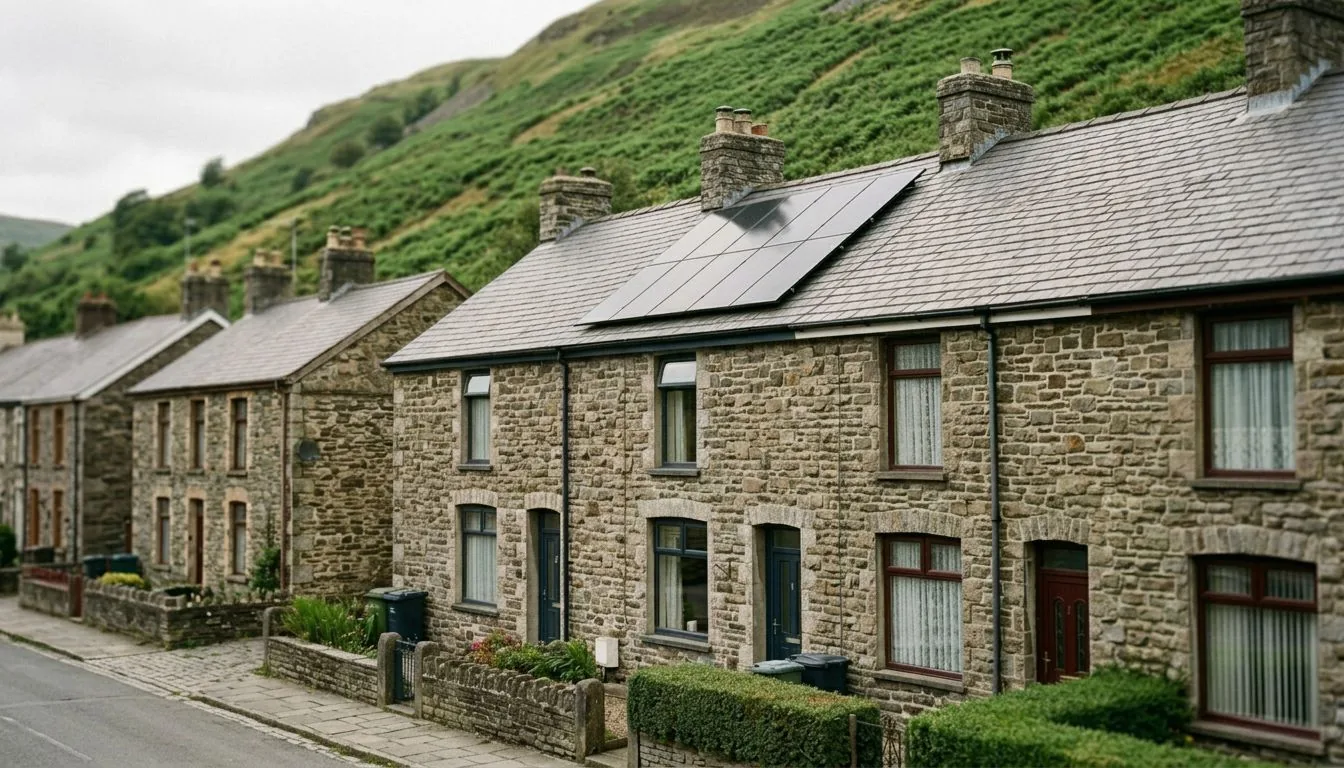
Quick answer: solar panels in Wales make about 950 kWh per kWp a year, so a 4 kWp system makes about 3,800 kWh. Lower-income households may get panels fitted free through the Welsh Government’s Nest scheme. Everyone else pays for them, and Welsh planning rules are separate from England’s.
This guide to solar panels in Wales covers local yield, costs, the Nest scheme and planning, while keeping each Welsh rule separate from England’s. Prices and rates are as at October 2026. For the basics, see our residential solar panels overview.
How much do solar panels make in Wales?
Wales has a wider spread of yields than most people expect, because the coast and the hills behave differently. The PVGIS model gives about 950 kWh per kWp a year for the nation as a whole. That sits close to the UK reference of 990.
The range across Welsh towns is wide:
- Bangor: about 805 kWh per kWp.
- Cardiff: about 1,030.
- Swansea: about 1,040.
- Aberystwyth: about 950.
- Wrexham: about 960.
So a south coast home can match the best of England, while the north-west coast lags well behind. All figures assume south-facing panels at a 35° tilt, since that is how PVGIS models them.
In Cardiff, December makes about a quarter of June’s output, however. Our guide to sizing a system to your usage shows how to turn a yield figure into a panel count.
Sources: PVGIS v5.2 (PVcalc, SARAH2 database, 14% losses, retrieved October 2026).
What a 4 kWp system means in Wales
A 4 kWp system has 9 or 10 panels and makes about 3,800 kWh a year at the Welsh figure. Since a typical home uses about 2,700 kWh, you would export a good share.
On our standard model, that earns and saves about £620 a year, so payback is about 12 years. The model assumes 30% self-use, 26.32p import and a 12p export rate. However, that rate is tied to buying your electricity from the same supplier.
For a wider look at the sums, see solar panel costs and savings in the UK.
Solar panel costs in Wales
Government cost data for 2025/26 gives a mean of £1,424 per kW for Welsh installs of 4–10 kW. That covers all installs and includes VAT. Quotes still vary a lot, because every roof differs, so compare at least three.
As a UK guide, a 4 kWp system costs about £6,500–£8,500 fitted. The 0% VAT rate lasts until 31 March 2027, although 5% applies after that. Our guide to solar panel installation costs explains what moves the price.
Sources: DESNZ solar PV cost data; HMRC VAT manual.
Nest and Warm Homes funding in Wales
The Welsh Government’s Nest scheme can fit free home improvements, and these can include solar panels. It is open to owner-occupiers and private renters, as long as they get a means-tested benefit or have a low income.
The home must also have a poor energy rating, specifically an EPC of 54 (E) or worse. If someone in the home has an eligible health condition, 68 (D) or worse can qualify. Nest decides which measures to fit, so do not assume solar will be included. The helpline is 0808 808 2244.
ECO4 also covers Wales, although it closes on 31 December 2026 with no successor. See current UK solar funding schemes for the full list.
Sources: Welsh Government: Nest; Nest eligibility.
Planning rules for solar panels in Wales
Wales follows its own permitted development order. Therefore, England’s reforms of 27 August 2026 do not apply here.
For a house, roof and wall panels must project no more than 200 mm. They must also sit below the ridgeline. On a flat roof, panels need to be at least 1 metre from the roof edge and no more than 1 metre above the roof plane.
In conservation areas and World Heritage Sites, you need consent for panels on a main or side wall that faces a highway. A stand-alone array is limited to one, 4 metres tall (2 metres within 5 metres of the boundary) and no more than 9 m².
Sources: Welsh Government guidance; WSI 2012/1346.
Slate roofs, terraces and rural plots
Welsh housing brings its own questions. For example, many valley terraces have slate roofs, which are brittle. Ask installers how they fix to slate and who covers any damage. Some owners also consider solar tiles versus panels.
Rural properties often have land to spare. While some roofs suit panels, if the roof is shaded or poorly angled, you could try putting panels in the garden instead. Remember the one-array limit above.
New homes follow Welsh building regulations, which differ from England’s. Our guide to solar on new-build homes has the detail.
Exporting your solar power in Wales
Because the Smart Export Guarantee covers Great Britain, it applies in Wales exactly as it does in England. Suppliers with 150,000 or more domestic customers must offer a tariff above zero. You need an MCS-certified installation and a smart meter. See comparing SEG export tariffs to pick one.
Next steps
Crossing the border changes little, since Bristol, just over the Severn, gets about 1,020 kWh per kWp, so read what solar generates in Bristol if you live near it. To compare Welsh yield with the north, see Scotland solar costs and support. When ready, get quotes from local installers with the form below.