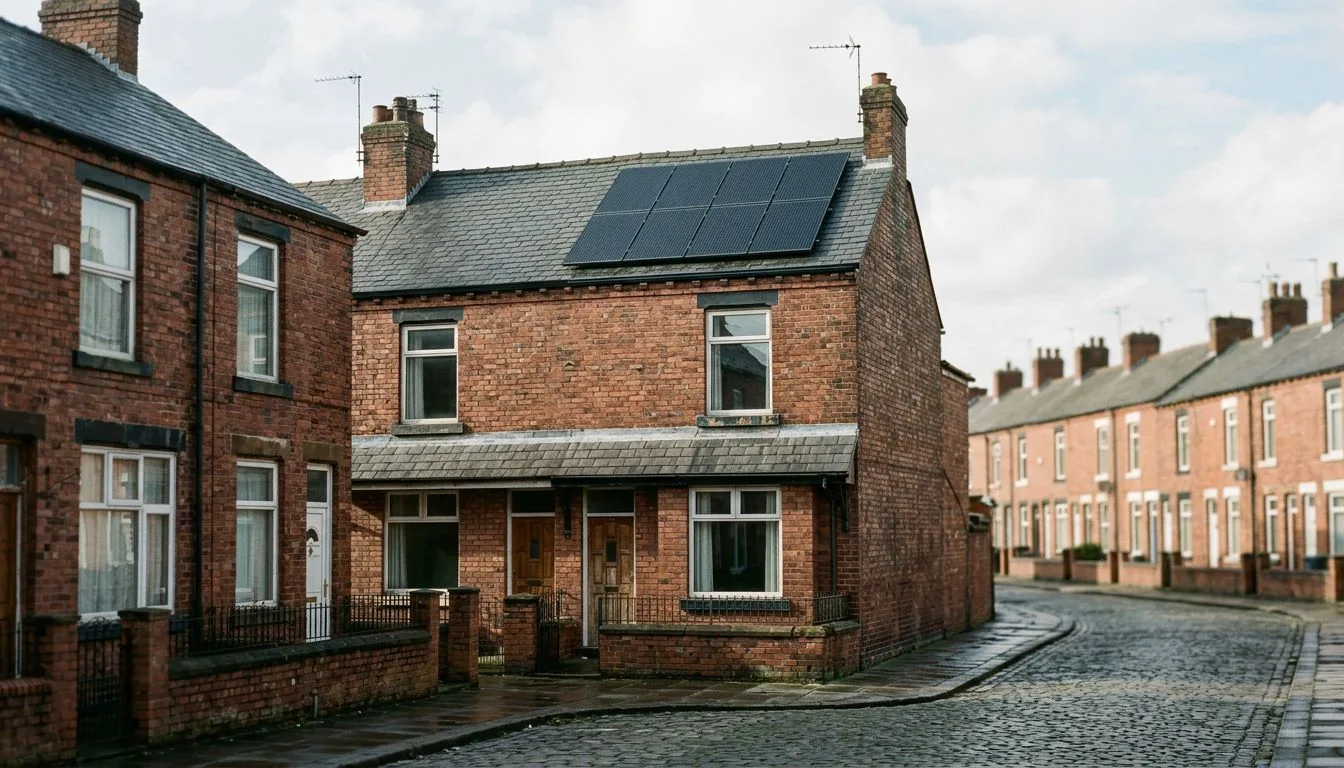
Quick answer: In Manchester, 1 kWp of south-facing panels makes about 885 kWh a year, so a 4 kWp system makes about 3,540 kWh. That is roughly 11% less than central England. Payback therefore lands nearer the long end of the national range, but panels last 25-30 years or more.
How much do solar panels make in Manchester?
Solar panels Manchester homeowners fit will usually make less than the national average. Using the EU’s PVGIS solar model, 1 kWp of south-facing panels at a 35-degree tilt in Manchester produces about 885 kWh a year. A 4 kWp system therefore makes about 3,540 kWh. For the basics of a home system, see our residential solar panels overview.
For comparison, the same model gives about 990 kWh per kWp for central England. Manchester sits about 105 kWh per kWp below that, or roughly 11%. Leeds is about 60 kWh per kWp ahead, and Birmingham is about 85 ahead.
Here is a surprise. A perfect Manchester roof (south-facing, 35 degrees, no shade) makes about 885 kWh per kWp. Our national model for a typical UK roof assumes 900. In other words, an ideal Manchester roof only matches a typical roof elsewhere.
Summer and winter in Manchester
Output swings sharply through the year. PVGIS gives about 109 kWh per kWp in June and about 28 kWh in December. December output is therefore roughly a quarter of June’s.
That is why a Manchester system is sized for the whole year, not the darkest month. It is also why solar output on grey days is worth understanding before you buy.
The rain myth
Manchester’s reputation for rain does not wipe out the sums. Panels generate in diffuse light, and the 885 figure already allows for the city’s real cloud cover. The loss against London is real, but it is measured in tens of per cent, not in “doesn’t work”.
What the lower yield means for payback
Our standard model uses a 4 kWp system costing about £7,500, with 900 kWh per kWp. At October 2026 prices it earns and saves roughly £590 a year, which pays back in about 13 years. The wider range is 11-15 years, depending on price, roof and export tariff.
Lower yield stretches that. On our model, payback is 12.8 years at 900 kWh per kWp and 11.5 years at 1,000. Each 100 kWh per kWp lost therefore adds about 1.3 years.
If Manchester’s 11% gap applies to a typical roof, you are near 800 kWh per kWp. That points to a payback of about 14 years with a 12p export rate, and longer on an open-market rate. Treat this as an estimate, not a quote.
Prices include 0% VAT, which ends on 31 March 2027. After that, VAT returns at 5%. See solar panel costs and savings in the UK for the full sums, and the calculator to estimate your system size.
Sources: PVGIS, DESNZ solar PV cost data, HMRC VAT manual.
Victorian terraces and blue slate roofs
Much of Manchester’s older housing is Victorian red brick. Manchester City Council’s conservation-area appraisals describe brick walls with stone dressings and roofs that were originally blue slate, for example in Whalley Range and Victoria Park.
That matters for solar in three practical ways.
First, a terrace gives you a modest roof slope. A 4 kWp system needs about 9-10 panels and 18-20 m² of clear roof, so a small rear slope may only fit a 2-3 kWp array. Ask for a design drawing before you accept a quote.
Second, slate needs careful fixing because it can crack. Ask the installer how they will hold panels on slate without cracking tiles.
Third, direction depends on the street. Terraced rows face opposite ways, so your best slope may be south-east, south-west, east or west. South-east and south-west roofs give about 93-95% of the ideal figure, and east or west roofs about 80%. Those percentages come from PVGIS runs for London, but the pattern holds in Manchester.
Renters in terraces should look at plug-in kits. If you rent, read about plug-and-play solar kits and plug-in solar panels. Since 27 August 2026, kits up to 800 W can be plugged into a normal socket in Great Britain, with conditions.
Manchester conservation areas and planning
Manchester has more than 30 conservation areas. They include Victoria Park, Chorltonville, Whalley Range and Withington, according to the council’s list and the national planning data.
In England, since 27 August 2026, rooftop solar on a house is usually permitted development. Panels must stick out no more than 200 mm from a pitched roof and sit no higher than the ridge. On a flat roof, the highest part can be up to 600 mm above the roof.
In a conservation area, roof panels are no longer barred just because they face a road. Panels on a wall or balcony that fronts a highway are still not permitted development there. Listed buildings always need consent.
Always check with Manchester City Council if your home is listed, in a conservation area, or covered by an Article 4 direction. An Article 4 direction can remove rights that would otherwise apply.
Sources: Manchester City Council conservation areas, planning.data.gov.uk, SI 2026/896 on legislation.gov.uk.
Connecting to the grid in Greater Manchester
Your local network operator is Electricity North West. Your installer should handle the paperwork, so ask them to confirm it in the quote.
To earn export payments you need an MCS-certified installer and a smart meter. Without an MCS certificate, you cannot be paid under the Smart Export Guarantee.
Export rates for Manchester homes
There is no fixed Smart Export Guarantee rate. Each supplier sets its own, so it pays to compare.
As at October 2026, Outgoing Octopus pays 12p per kWh, but only if you also buy electricity from Octopus on an eligible tariff. Octopus’s open tariff for non-customers pays 4.1p. Open-market rates run at about 3-6p. Our model assumes 12p.
Check each supplier’s current terms before you sign anything. Rates change often.
Sources: gov.uk on the Smart Export Guarantee, Octopus Outgoing, Ofgem price cap, Oct-Dec 2026.
Batteries and EVs on Manchester roofs
With lower summer surplus than southern England, using more of your own power matters more here. A battery stores the midday surplus for the evening. Adding a 5 kWh battery with new panels typically adds £2,500-£4,000.
On a flat-rate tariff, our model puts payback at about 15-16 years with a battery. It does better on a cheap overnight tariff, which the model leaves out. See the best solar batteries compared and solar battery storage costs and benefits.
If you drive an EV, daytime charging uses solar directly. Read about pairing solar with an EV charger before you choose a system size.
Next step for Manchester homeowners
Get at least two quotes, and ask each installer for a PVGIS-style yield estimate for your exact roof. A good installer will model your slope, direction and shading, not just quote a city average. You can request free installer quotes through this site.