Quick answer: there are no Scottish solar panel grants for standard panels any more. Home Energy Scotland only offers a £5,000 interest-free loan, and only for hybrid PV-T panels. A typical 4 kWp system in Scotland makes about 3,480 kWh a year, so it still pays its way.
This page covers solar panel grants in Scotland and the local facts that change the sums, such as yield, cost and planning, while also looking at the roofs you will be working with. Prices and rates are as at October 2026. For the basics, see how a domestic solar system fits together.
Solar panel grants in Scotland: what Home Energy Scotland funds
The picture has narrowed because Home Energy Scotland stopped funding ordinary solar PV panels and batteries in June 2024. Today it supports only hybrid PV-T systems, which make electricity and hot water from the same panel.
That support is a loan, not a grant. You can borrow up to £5,000 interest-free, although you must use an MCS-certified installer and product. The helpline is 0808 808 2282.
ECO4, the supplier-funded scheme, also closes on 31 December 2026, with no successor. As a result, it is not a route to plan around. For the wider view, see our guide to solar panel grants available in the UK.
Sources: Home Energy Scotland grant and loan; GOV.UK ECO4 response.
How much power do panels make in Scotland?
Although Scotland gets less sun than the south of England, the gap is smaller than most people expect. The UK reference figure is 990 kWh per kWp a year. Our Scottish figure is 870, about 12% lower.
The PVGIS model gives a spread across the country:
- Inverness: about 805 kWh per kWp.
- Glasgow: about 850.
- Aberdeen: about 905.
- Edinburgh: about 915.
- Dundee: about 935.
For a 4 kWp system, that means roughly 3,220 kWh in Inverness and 3,740 kWh in Dundee. Since all figures assume south-facing panels at a 35° tilt, a shaded or east-west roof will make less.
Winter is the weak spot, because in Glasgow, December output is under a fifth of June’s. Edinburgh does slightly better, at about a fifth. Our guide to how panels perform in winter and cloud explains why the summer months carry the year.
Sources: PVGIS v5.2 (PVcalc, SARAH2 database, 14% losses, retrieved October 2026).
What a 4 kWp system means for a Scottish home
A 4 kWp system uses 9 or 10 panels and makes about 3,480 kWh a year at the Scottish figure. Since a typical home uses about 2,700 kWh, most of the surplus is exported.
On our standard model, with 30% self-use, an import price of 26.32p and a 12p export rate, that is roughly £570 a year. Payback comes out at about 13 years. The 12p export rate is only available if you also buy your electricity from the same supplier.
Lower yield means you need more panels to match a southern home. Therefore, to reach 4,100 kWh at 870 kWh per kWp, you would need about 4.7 kWp. In practice that is a 5 kWp system of 11 or 12 panels. See how many panels a typical home needs for the sizing method.
Solar panel costs in Scotland
Government data for 2025/26 puts the Scottish mean for installs up to 4 kW at about £1,767 per kW. That covers all installs and includes VAT, while London’s equivalent figure is £2,101 per kW.
As a UK guide, a 4 kWp system costs about £6,500–£8,500 fitted, including 0% VAT. The zero rate ends on 31 March 2027, when 5% returns. Our pages on typical UK solar costs and payback and what fitting solar panels costs give the full breakdown, because prices vary by roof.
Quotes vary, so always compare at least three.
Sources: DESNZ solar PV cost data; HMRC VAT manual.
Scottish planning rules for solar panels
However, Scotland does not follow England’s planning rules. The English changes of 27 August 2026 do not apply here. Instead, Scottish householder permitted development lets most rooftop solar go ahead if it projects no more than 1 metre from the wall or roof surface.
Since 2024, panels in conservation areas can also be permitted development on rear elevations, and on side elevations that do not face a road. Listed buildings and their curtilage are excluded. Flats follow separate rules.
Because Scotland also sets its own building standards, new-home rules differ. Our guide to new-build solar rules covers how they differ.
Sources: Scottish Government Circular 1/2024; SSI 2024/102.
Roofs and housing to think about in Scotland
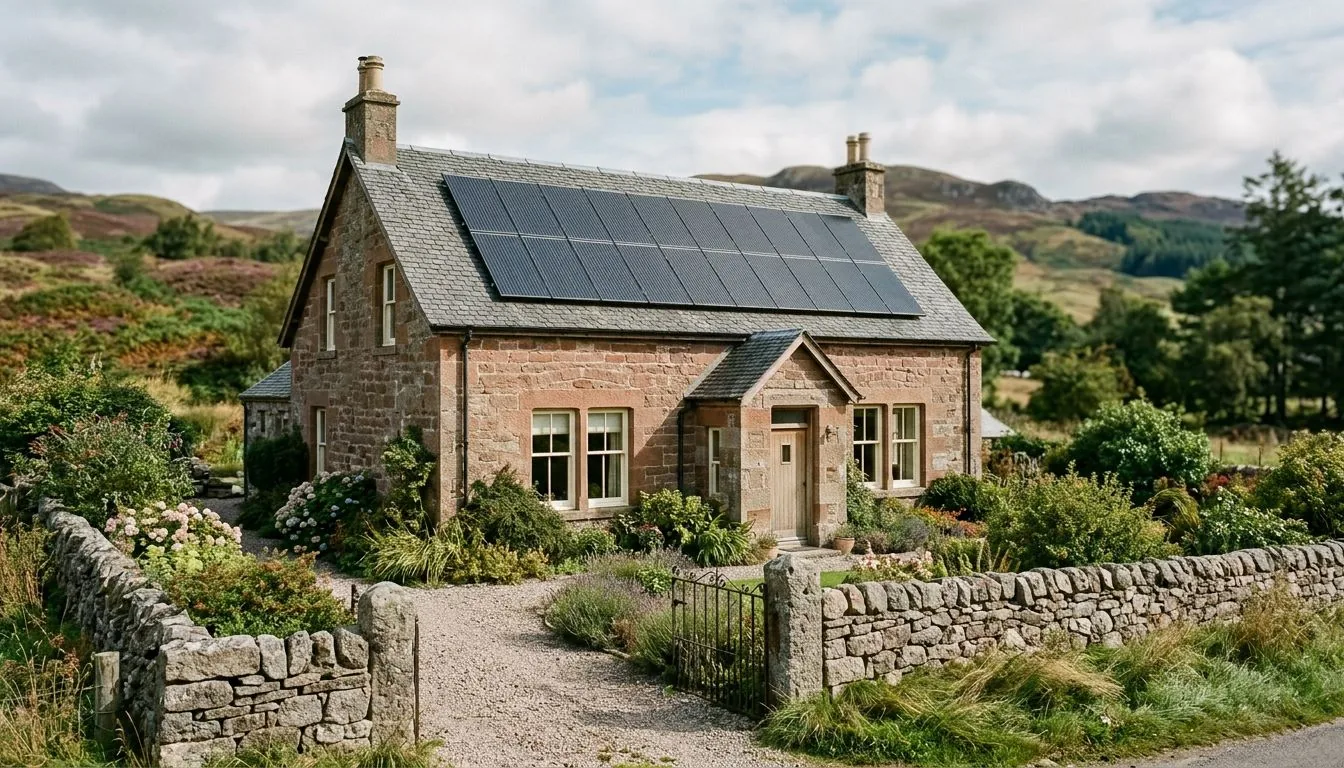
Housing here is varied, and that matters for solar. For example, stone-built homes often have slate roofs, so ask installers how they fix to slate. Exposed coastal and upland sites also mean strong wind, so ask what the mounting system is rated for.
Tenement flats raise a different issue because the roof is typically shared. So check your title deeds and agree plans with your neighbours before anything else.
Rural plots have more choice, since a garden or paddock can take a ground-mounted array, which lets you choose the best angle. Our guide to ground-mounted solar arrays covers the costs and rules.
Exporting solar power in Scotland
Because the Smart Export Guarantee covers Great Britain, Scottish homes qualify like English ones. Every supplier with 150,000 or more domestic customers must offer a tariff. Each sets its own rate, which must be above zero.
You need an MCS-certified installation and a smart meter. Open-market rates are about 3–6p per kWh, while customer-tied tariffs can reach 12p or more. See the best Smart Export Guarantee rates before you sign up.
Next steps
Next, compare quotes. Neighbouring nations have different rules, so while you are here, you may also want to read about solar panels in Northern Ireland and Wales solar costs and support. When you are ready, request free installer quotes using the form below.