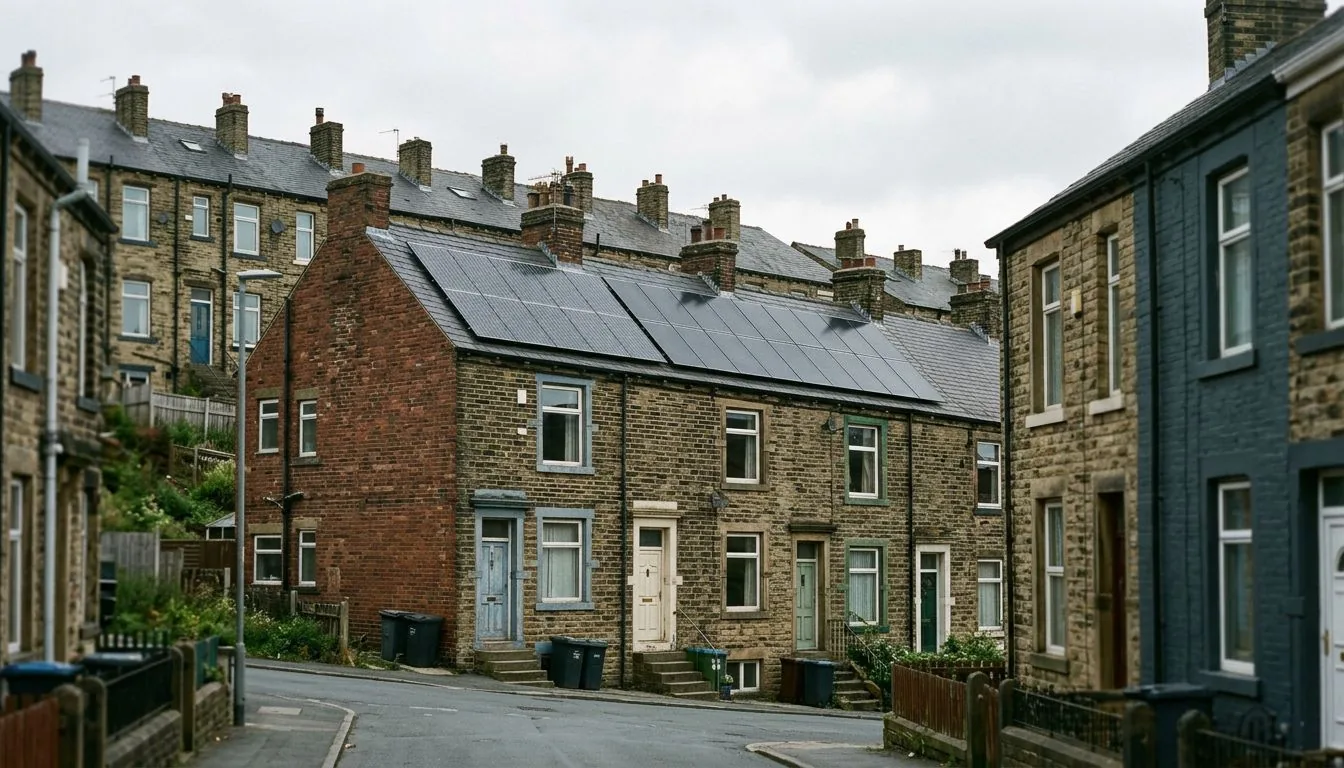
Quick answer: In Leeds, 1 kWp of south-facing panels makes about 945 kWh a year, so a 4 kWp system makes about 3,790 kWh. That is about 4% below central England and ahead of every Scottish city in the PVGIS table. In Leeds, the direction of your street often matters more than the city.
How much do solar panels make in Leeds?
Solar panels Leeds homeowners buy make about 945 kWh per kWp a year, using the EU’s PVGIS model. That assumes south-facing panels at a 35-degree tilt. A 4 kWp system makes about 3,790 kWh. To see how a domestic solar system fits together, start with our overview.
The central-England reference is about 990 kWh per kWp. Leeds is about 4% below it. It is about 60 kWh per kWp ahead of Manchester, while the figure falls further north.
Leeds also beats every Scottish city in our table. Dundee is 935, Edinburgh 915, Aberdeen 905 and Glasgow 850. See what solar generates in Scotland for the full northern picture.
Why your street direction matters
Leeds is a city of terraces, and terraces come in long parallel rows, so that has a direct effect on solar.
In a row, the roofs on opposite sides of a street face opposite ways. If the street runs east to west, one side faces roughly south and the other faces roughly north. If it runs north to south, both sides face east or west.
PVGIS runs for London show how much that costs:
- South-east or south-west roofs give about 93-95% of the ideal south-facing figure.
- East or west roofs give about 80%.
- North-facing roofs give only about half.
The same pattern holds in Leeds, because the geometry of the sun is the same. A south-facing slope at 945 kWh per kWp becomes about 755 kWh on an east or west roof, using the 80% figure. That is an estimate from the PVGIS pattern, not a Leeds measurement.
However, the fix is a proper design, not a bigger system. Ask your installer to model each slope on your house.
Stone, slate and back-to-backs
Leeds has a distinctive housing stock. In Headingley and Hyde Park, Leeds City Council’s appraisal says terraced housing predominated in the later nineteenth century, close to Woodhouse Moor. Older houses across the city are built in brick or local gritstone, and many have slate roofs.
Back-to-back houses, built in rows with a shared rear wall, are a Leeds speciality. Although a national ban applied to new ones, Leeds did not enforce it, and they were built here until the 1930s.
Roofs on older stone and slate houses need care at installation, because slate can crack. Ask how the installer will fix to slate, and how they will avoid damaging it. Read about the main types of solar panel for the choices on offer.
Once the panels are on, a roof still needs looking after. Our guide to looking after your panels covers gutters, bird droppings and checks.
If you are buying in Leeds, find out what to check when a home comes with panels in buying a house that already has solar panels.
Sources: PVGIS, Leeds City Council Headingley Hill, Hyde Park and Woodhouse Moor appraisal, Back-to-back house on Wikipedia.
Leeds’s 80 conservation areas
Leeds City Council states that there are 80 conservation areas in the Leeds district. They include Headingley Hill, Hyde Park and Woodhouse Moor.
The council’s conservation-area page lists some solar panels among works that can need planning permission there. That page may pre-date the English rules that came into force on 27 August 2026, so ask the council to confirm.
Under the current English rules, rooftop solar on a house is usually permitted development. A pitched roof array may stand no more than 200 mm proud of the roof and no higher than the ridge. A flat-roof array may rise up to 600 mm.
In a conservation area, roof panels are no longer barred just because they face a road. Panels on a wall or balcony that fronts a highway still need consent, and so does any work on a listed building.
Check with Leeds City Council if your home is listed, in a conservation area, or covered by an Article 4 direction.
Sources: Leeds City Council conservation areas, SI 2026/896 on legislation.gov.uk.
What you save in Leeds
Our standard model uses a 4 kWp system costing about £7,500 and 900 kWh per kWp. At October 2026 prices it saves and earns roughly £590 a year, and pays back in about 13 years. The wider range is 11-15 years.
Leeds is about 4% below the central-England reference. A typical Leeds roof should therefore pay back close to 13 years, and perhaps a little over. Each 100 kWh per kWp lost adds about 1.3 years on the model, so a small gap makes a small difference.
Prices include 0% VAT, which ends on 31 March 2027. After that, 5% returns. See typical UK solar costs and payback, and use the calculator to estimate your system size.
Cloud is not the problem some expect, because panels generate in diffuse light. Read about solar output on grey days to see how winter output compares.
Pigeons in the city
Leeds roofs have to deal with city birds. Pigeons are a risk because they nest under panels if the gap is open. Mesh and clips fix this cheaply at installation. See keeping pigeons out from under panels.
Connecting and exporting in Yorkshire
Northern Powergrid is the network operator for Leeds. Your installer should handle the application, so ask them to confirm it.
To earn export payments, you need an MCS-certified installer and a measured export, normally through a smart meter. There is no fixed Smart Export Guarantee rate. Each supplier sets its own, so it pays to compare.
As at October 2026, Outgoing Octopus pays 12p per kWh, but only to Octopus electricity customers on an eligible import tariff. Open-market rates run at about 3-6p. Our model assumes 12p.
Sources: gov.uk on the Smart Export Guarantee, Octopus Outgoing.
Renting a Leeds terrace
If you rent, a plug-in kit may be easier than a roof array. Since 27 August 2026, kits up to 800 W can be plugged into a normal socket in Great Britain, with conditions. You must tell your network operator, and you need landlord consent first. Read about plug-and-play solar kits.
Get Leeds quotes
Tell each installer your street direction and roof slope. Then request free installer quotes through this site, and compare at least two.